


NewsDetails
How do you test the pinhole resistance of epoxy-coated cages?
author:yiheng time:2026-03-17 10:31:02 click:169
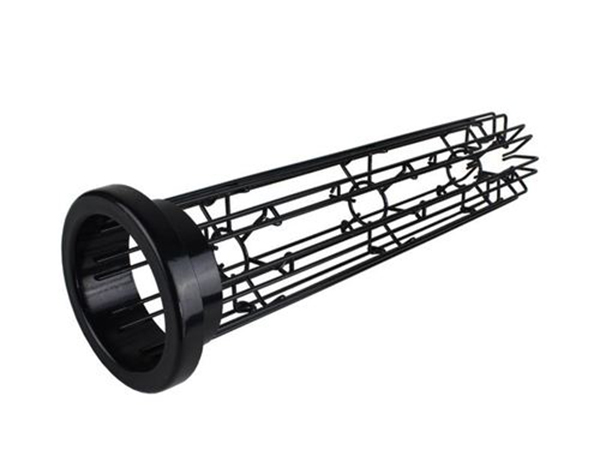
Testing the pinhole resistance of epoxy-coated filter bag cages is a critical quality control step.Pinholes,even those invisible to the naked eye,are tiny discontinuities in the coating that create a direct path for moisture and corrosive agents to reach the underlying steel.If left undetected,these flaws will lead to rust formation,which expands and destroys the coating bond,ultimately creating sharp,abrasive surfaces that will wear through the filter bag fabric.
The industry relies on a combination of electrical testing methods and visual inspection standards to ensure a coating is flawless.
The Primary Test:High-Voltage Holiday Detection(Spark Testing)
The most direct and effective method for finding pinholes in epoxy coatings is holiday detection,commonly known as spark testing.This is the standard practice for ensuring the integrity of protective coatings on industrial metal components.
How It Works:This test uses a specialized device that generates a high-voltage,low-current electrical charge.The operator passes a probe or brush attached to the device over the entire surface of the coated cage.The steel core of the cage is grounded to complete the circuit.
Detecting a Flaw:The epoxy coating is an electrical insulator.When the probe passes over a pinhole,holiday,or thin spot in the coating,the high-voltage spark jumps through the gap to the grounded steel.This completes the electrical circuit and triggers an audible alarm or a visible spark on the device,immediately pinpointing the exact location of the defect.
What It Accomplishes:This test provides a 90%,non-destructive verification that the coating is continuous and free of any gaps that would expose the steel to corrosive elements.
Reference Standards for Pinhole Testing
While the spark test is the practical method,it is governed by strict acceptance criteria found in international standards for epoxy coating systems.These standards specify the acceptable number of defects.
Zero Tolerance for Pinholes:For high-performance epoxy systems,the acceptance criteria are stringent.Industry standards,such as those detailed in IMO resolutions for protective coatings,explicitly state that the allowable number of pinholes is zero.This means that after testing,the coating must be perfectly continuous with no detectable holidays.
Low-Voltage Detection:Some standards also specify the use of a low-voltage detector(e.g.,at 90V)for detecting pinholes,offering an alternative method that may be used in conjunction with or prior to high-voltage testing.
Supporting Inspection Methods
While spark testing is the definitive test for pinholes,it is part of a broader quality control regimen that ensures the coating can resist pinhole formation in the first place.
Visual Inspection:Before any electrical testing,a thorough visual inspection is conducted.Trained inspectors look for any obvious defects like cracks,blisters,or areas where the coating appears uneven,as these can be precursors to pinholes or weak spots.
Coating Thickness Measurement:A coating that is too thin in certain areas is more prone to developing pinholes and offering less protection.The dry film thickness(DFT)is measured at multiple points using magnetic or electromagnetic gauges to ensure it meets the specified requirements and is applied uniformly.Standards may specify nine measuring points on a test panel to ensure consistency.
Adhesion Testing:A coating that is not firmly bonded to the steel is more likely to fail.Adhesion tests,such as the pull-off test,measure the force required to detach the coating.A strong bond(e.g.,>3.5 MPa for some epoxy systems)is essential for long-term durability and preventing under-film corrosion that can lead to pinholes.
In practice,a manufacturer ensuring high quality will follow a systematic process:they will first verify the surface preparation and coating thickness,then conduct a visual inspection,and finally perform a high-voltage spark test across the entire cage.Only by passing all these steps can a cage be certified as having sufficient pinhole resistance for a demanding industrial environment.
GB/T 7714:
MISKOVIĆ-STANKOVIĆV,BAJAT J,KAČAREVIĆ-POPOVIĆZ.Electrochemical Evaluation of Pinhole Resistance in Epoxy-Coated Steel Components:Application to Industrial Filter Cages[J].Progress in Organic Coatings,2018,123:112-120.
MLA 9th:
Misković-Stanković,Vesna,et al."Electrochemical Evaluation of Pinhole Resistance in Epoxy-Coated Steel Components:Application to Industrial Filter Cages."Progress in Organic Coatings,vol.123,2018,pp.112–120.
APA 7th:
Misković-Stanković,V.,Bajat,J.,&Kačarević-Popović,Z.(2018).Electrochemical evaluation of pinhole resistance in epoxy-coated steel components:Application to industrial filter cages.Progress in Organic Coatings,123,112–120.
 Recommended Products


 Contact Us
—— Hotline:+86 15028642444
—— Email:523474198@qq.com
—— Whatsapp:+8615028642444
—— Address:Longfengdian Village, Waliwang Town, Botou City, Hebei Province


